24th Ordinary Sunday
Audio
24th Ordinary Sunday Matthew 18:21-35
In the scriptures forgiveness, like sin, is a constant theme. God forgives his people; his people forgive one another. This explains much about our religion. In ordinary society punishment for a crime is the expected reaction. However, if the state were to forgive every crime, anarchy would result. This tells us much about the human condition. The state cannot expect forgiveness to bring about reform. Experience tells us a sadder story. We, my friends, are not the state, we are Christians.
Our first reading is from the book of Sirach; a saintly man who lived 200 years before Christ came on this earth. He had no knowledge of God’s infinite love and mercy, which was manifested by the Incarnation and demonstrated by the Son of God. In today’s passage we are told that we must forgive others if we expect God to forgive us our sins. We must be merciful if we hope to obtain mercy from God. If you forgive others then God will listen to your request for forgiveness. Our Lord Jesus echoed these words of Sirach when he told us to say: “Forgive us our trespasses as we forgive those who trespass against us.”
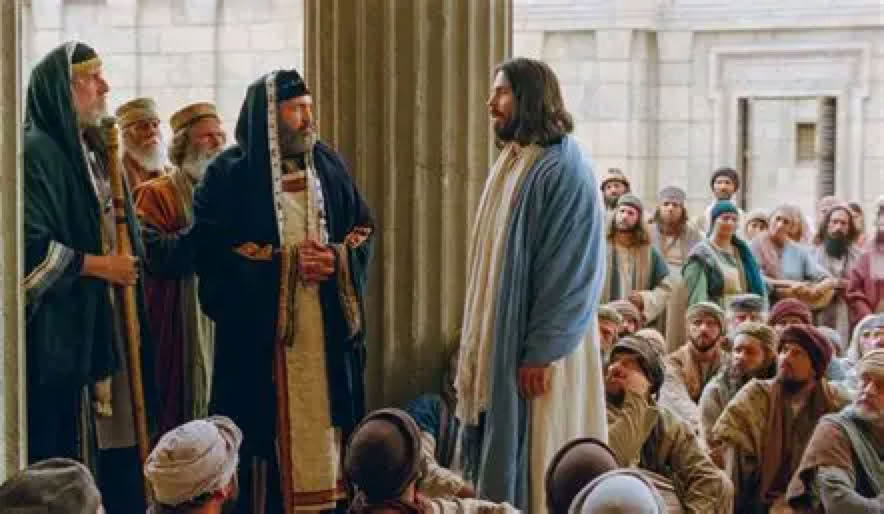
Then in the gospel Jesus remembers these words of Sirach when Peter asks him: “do I have to forgive someone seven times.” His question indicates that our impetuous Peter thinks seven times is a large amount. But, surprise, surprise, the Lord says to Peter, you must forgive “seventy times seven.” Now this figure in Hebrew means the same as “always.” Thus the Lord did not limit forgiveness to a fixed number, but declared that it must be continuous and forever.
Jesus, then, goes into a parable that is a basically a short play acting out the overwhelming mercy and forgiveness of God and the ungenerous, calculating approach to forgiveness of man. So let’s get into the math in the parable, which was easily understood by those present. A talent was equivalent to six thousand denarii, a single denarius was a working man’s daily wage. The first servant, we are told, owed the king ten thousand talents, — an enormous sum that couldn’t be paid in a lifetime. The forgiveness of the Lord shows the disciples, and us, the immense value of the forgiveness and mercy of this Lord, who is God. In comparison, the second servant, owes the first servant 100 denarii, an amount that could be resolved by a hundred days of labor or less; a pittance compared to his own debt.
Of course when the Lord hears what the forgiven servant has done to his own debtor he becomes very angry. This man begged for mercy and received mercy, but was unwilling to give any mercy to his brother servant. The Lord then assigns a punishment to him who would not show mercy that is equal to what he gave to his friend.
You and I, my friends, should take a minute today to consider whether we are like the merciless servant in our parable. Every time we commit a mortal sin we incur an unpaid, impossible debt to God. Thus each time we receive absolution in the sacrament of reconciliation, or baptism we have received God’s loving, infinite mercy no matter the size of our debt.
So how can it be possible that we can be so heartless and mean as to be unforgiving to another who has done something much less against us? Yet it happens, and it may be that some among us continue to have anger or even worse, vengeance against others. My friends, it is our Christian duty to try to give as much mercy as we receive from God. — With love in our hearts we must walk away and leave it behind us; — forgive and forget it.
There is still time for us to forgive all our enemies from our heart. If we do not, we are cutting ourselves off from the possibility of having our own sins and offenses forgiven by God. “So also my heavenly Father will do to every one of you, if you do not forgive your brother from your heart.” Amen.
© JOSEPH MEILINGER 2026